
Introduction
In the automotive and aerospace manufacturing sectors, components must withstand extreme conditions while adhering to precision requirements measured in millimeters or even microns. However, companies often face a dilemma: enhancing precision typically leads to soaring costs and extended production cycles. The root cause of this contradiction lies in inefficient traditional manufacturing processes, significant material waste, and production systems lacking the flexibility to handle complex designs and rapid iterations. This article will delve into how integrating advanced CNC Turning Services, intelligent process planning, and rigorous quality control systems can achieve significant cost reductions while maintaining or even improving part accuracy. The following key dimensions reveal the complete path of this manufacturing transformation.
Why Do Traditional CNC Turning Methods Struggle with Complex Components?
Traditional 3-axis lathes face significant limitations when machining automotive engine parts or aerospace hydraulic fittings with features like eccentric holes or compound curved surfaces. The discrete nature of these operations necessitates multiple setups, introducing cumulative alignment errors. This often forces manufacturers into additional secondary machining, such as CNC Milling Services, and incurs high costs for specialized fixtures.
As the Society of Manufacturing Engineers (SME) points out in its analysis of “Future Machine Tool Technology Trends,” discrete processing is a major bottleneck to efficiency improvement, highlighting the industry’s inevitable shift towards integrated solutions.
How Does High-Precision Turning Achieve Stringent Tolerances of ±0.005mm?
Achieving ultra-high precision relies on a triad of technological pillars working in concert.
The Foundation: Advanced Machine Tool Architecture
Modern high-rigidity, 5-axis CNC turning and milling services centers provide the stable platform necessary for complex motion trajectories and superior surface finishes. To delve deeper into the relationship between toolpath and accuracy, one can refer to this detailed explanation on CNC precision turning.
The Enablers: In-Process Control and Compensation
- Thermal Error Compensation:
Real-time monitoring and software compensation counteract thermal deformation of the machine tool structure and spindle, a critical factor for consistent accuracy. - Closed-Loop Feedback Systems:
On-machine probing and laser measurement systems create a closed-loop, allowing for real-time tool wear compensation and in-process verification of precision turned parts.
The Execution: Optimized Cutting Strategy
The final precision of a part is heavily influenced by the machining strategy. For challenging materials like titanium alloys or high-strength aluminum, this involves meticulous selection of cutting tool geometry, substrate, and coatings, coupled with optimized cutting parameters (speed, feed, depth of cut). This underscores the importance of process control, laying the groundwork for the quality standards discussed later.
How to Balance the High Volume vs. High Quality Cost Equation in Mass Production?
For high volume precision turned parts, the strategy shifts from individual part optimization to systemic production flow efficiency. This involves designing dedicated, quick-change fixtures, integrating automated loading/unloading systems, and implementing sophisticated tool life management to minimize unscheduled downtime.
By optimizing these elements, high volume CNC machining can achieve significant economies of scale. For instance, in a real-world case involving a brake system component manufacturer, a holistic process redesign led to a 30% reduction in per-part cost while maintaining stringent quality metrics. The application of lean manufacturing principles is central to this success, focusing on waste elimination and continuous flow in Custom Parts Production.
Integrated Turning-Milling Centers: A One-Stop Solution for All Problems?
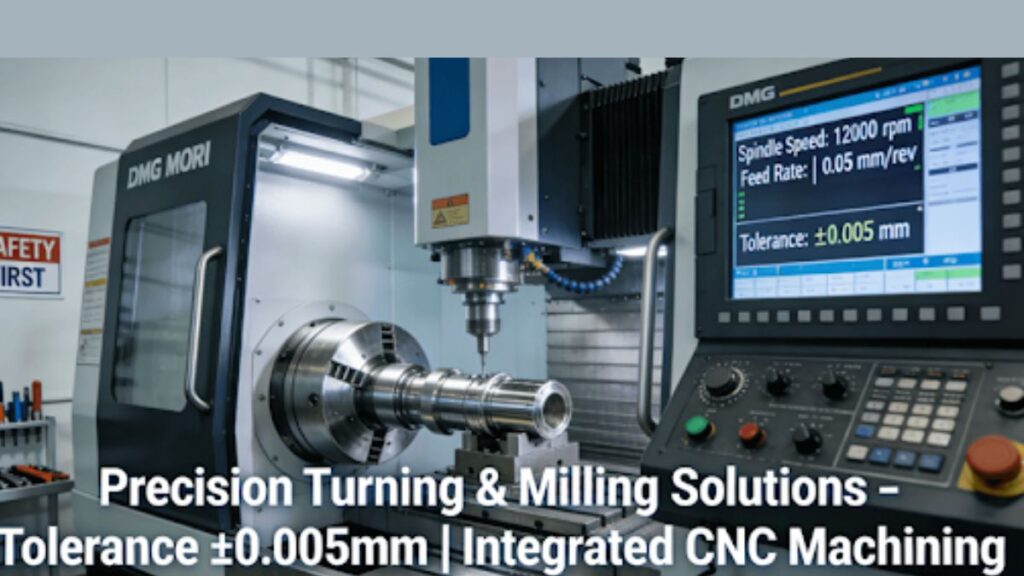
CNC turning and milling services performed on a single multi-tasking machine represent a paradigm shift. These centers combine turning, milling, drilling, and tapping capabilities, completing a part in one setup. Contrast this with the traditional model of separate turning and outsourced milling: the integrated approach demonstrably shortens lead times by up to 60%, eliminates handling damage between machines, and drastically simplifies supply chain management.
The benefits extend beyond efficiency. As research from the Institution of Engineering and Technology (IET) on “The Impact of Integrated Manufacturing Systems on Carbon Emissions” indicates, such integrated manufacturing cells can effectively reduce in-plant logistics carbon emissions by over 15%, adding a sustainability angle to their value proposition as comprehensive CNC Machining Solutions.
How Critical Are International Quality Certifications When Selecting a Supplier?
In Precision Manufacturing Services, certifications are far more than framed certificates; they are a testament to a systemic commitment to excellence and risk mitigation.
Decoding the Certification Spectrum
International quality certifications are foundational to credible Precision Manufacturing Services. Key standards include ISO 9001 for Quality Management, the stringent IATF 16949 for automotive, AS9100D for aerospace, and ISO 14001 for Environmental Management. Each represents an independently audited framework for process control, continuous improvement, and preventive action, tailored to specific industry risks and requirements.
From Compliance to Competitive Assurance
Far from mere paperwork, these certifications translate into tangible reliability for precision turned parts by instilling a proactive quality culture.
- Systematized Process Control:
The standards mandate traceable process control systems and a risk-prevention mindset. This structured environment is the fundamental guarantee for consistent part quality, turning abstract principles into a reliable production system.
- A Strategic Partnership Filter:
Evaluating a supplier’s certifications serves as a critical strategic filter. It efficiently identifies partners whose operational maturity aligns with high-stakes industry demands, ensuring quality is engineered into the process from the very start.
Conclusion
In summary, modern precision manufacturing has evolved from a competition of individual machines to a systemic contest encompassing advanced processes, intelligent production management, and top-tier quality systems. By adopting integrated CNC turning-milling solutions and adhering to internationally recognized production frameworks, manufacturing enterprises can effectively break the traditional trade-off between precision and cost, establishing a decisive advantage in the high-end component manufacturing arena.
If you are seeking a manufacturing solution for a critical project’s components that must meet extreme precision requirements while optimizing costs, it is advisable to thoroughly evaluate partners with comprehensive technical capabilities and international qualifications. For instance, the end-to-end services offered by JS Precision could become a pivotal element in your technical blueprint.
Author Biography
This article was authored by an industrial technology consultant with over a decade of experience in advanced manufacturing and supply chain optimization, specializing in the innovative application and cost-benefit analysis of CNC precision machining technology in the automotive and aerospace sectors.
FAQ Section
Q: What types of parts are primarily suitable for CNC turning?
A: CNC turning is primarily suitable for rotationally symmetrical parts such as shafts, sleeves, flanges, and threaded components. It is a core process for producing metal or plastic parts with high concentricity and cylindricity.
Q: What are the advantages of turn-mill compound machining compared to separate turning and milling?
A: The greatest advantage lies in completing multiple operations in a single setup, eliminating repeated positioning errors, significantly improving machining accuracy and efficiency, while shortening the overall production cycle. It is particularly suitable for structurally complex precision parts.
Q: How can one determine if a CNC machining service provider can handle high-volume orders?
A: The key indicators are the automation level of their production lines, standardized process flows, tool management systems, and capacity planning capabilities. Manufacturers experienced in high volume CNC machining typically have well-established lean production systems.
Q: What do IATF 16949 and AS9100D certifications mean for a manufacturer?
A: These signify that the manufacturer’s quality management system meets the extremely stringent requirements of the automotive and aerospace industries, respectively, encompassing risk control, traceability, and continuous improvement. They are essential entry tickets for high-end manufacturing.
Q: When searching for local CNC services, is the search term “CNC milling services near me” reliable?
A: While geographic proximity can facilitate communication and logistics, the primary evaluation criteria should be technical capability, equipment level, and quality certifications. For high-precision projects, technical compatibility is more critical than mere geographical closeness.